

Positive Steps for Small Businesses, But Will They Make a Real Difference?
Welsh ICE’s analysis of the Autumn Budget 2026 and what it means for small businesses, sole traders and freelancers in Wales.
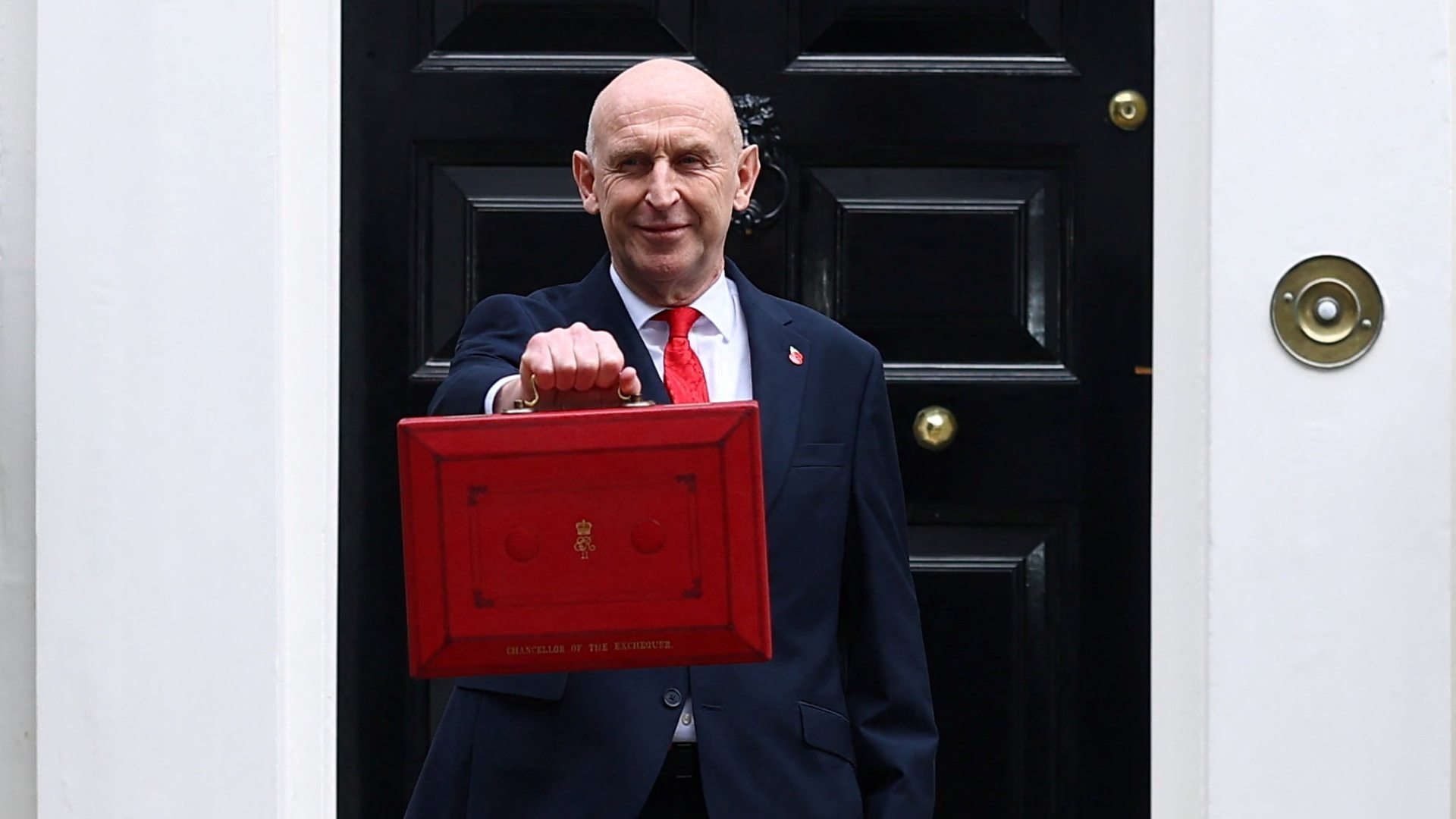
Yesterday’s Autumn Budget brought a welcome acknowledgement from Chancellor John Healey of the challenges facing Britain’s small businesses, entrepreneurs and sole traders.
It was particularly encouraging to hear the Chancellor recognise that, for many self-employed people, the cost of living and the cost of doing business are effectively the same thing. When your home is your office and your family car is also your work vehicle, the distinction between household finances and business finances becomes increasingly difficult to make.
This is something we see regularly within the Welsh ICE community. Small businesses don’t operate in isolation from the people running them. Rising household costs affect business confidence, investment decisions and the ability to take risks.
The Budget contained a considerable number of positive, if often relatively small and targeted, announcements.
There may not have been one headline policy that fundamentally transforms the operating environment for small businesses, but there were certainly measures worth welcoming.
The bigger question is whether these changes, taken together, will make a meaningful difference to the everyday experience of running a business.
This is something we see regularly within the Welsh ICE community. Small businesses don’t operate in isolation from the people running them. Rising household costs affect business confidence, investment decisions and the ability to take risks.
The Budget contained a considerable number of positive, if often relatively small and targeted, announcements.
There may not have been one headline policy that fundamentally transforms the operating environment for small businesses, but there were certainly measures worth welcoming.
The bigger question is whether these changes, taken together, will make a meaningful difference to the everyday experience of running a business.
Small changes that could make a real difference
For sole traders, freelancers and those considering starting a business, several announcements stand out.
The decision to triple the trading allowance from £1,000 to £3,000 from April 2027 is particularly welcome. For people testing a business idea alongside employment, or gradually building income through self-employment, this removes an important financial and administrative barrier.
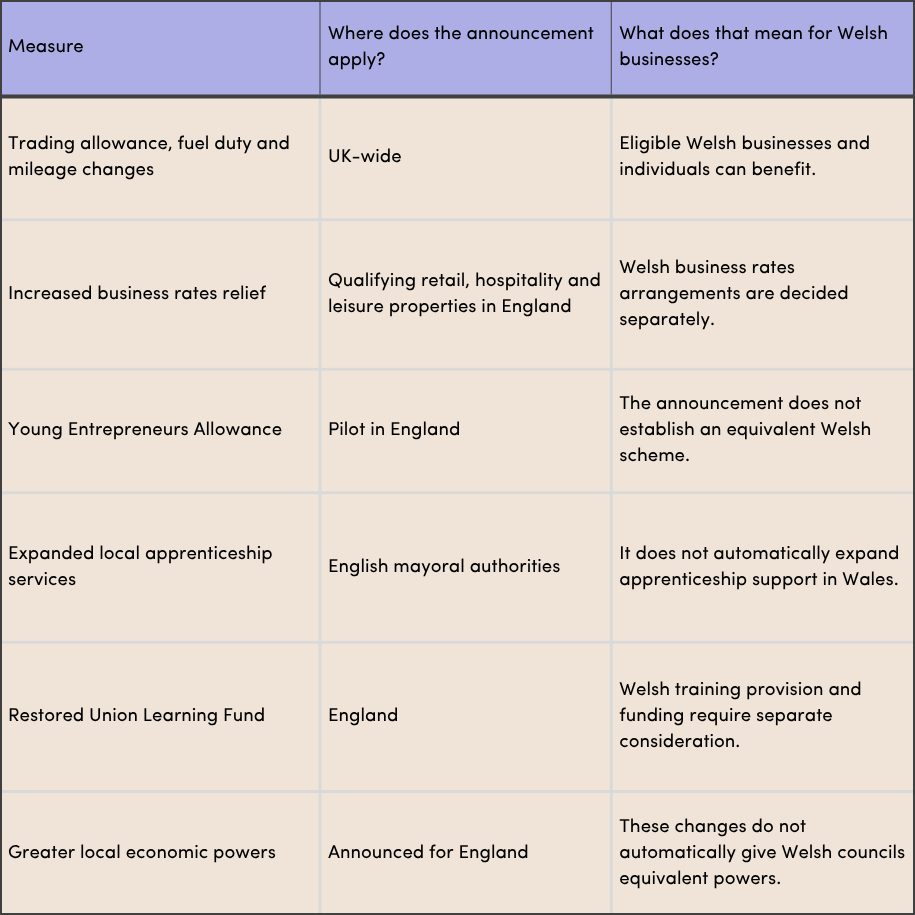
The introduction of a Young Entrepreneurs Allowance, providing eligible young founders in England with support towards living costs during their first year, also recognises something we have long understood at Welsh ICE: starting a business requires more than a good idea. People need the financial security and confidence to give that idea a chance.
Similarly, extending parental pay to eligible self-employed fathers and partners from 2029 is a positive step towards addressing inequalities between employment and self-employment.
For businesses that rely on driving, including tradespeople, delivery services and freelancers travelling to clients, there were also some welcome changes. The Government has extended the existing 5p per litre cut in fuel duty until July 2027, helping to keep petrol and diesel costs lower than they would otherwise be.
It has also increased the tax-free mileage allowance for people using their own cars or vans for business journeys. They can now claim 55p per mile for the first 10,000 business miles each year, up from 45p, and 35p per mile thereafter, up from 25p. For a self-employed person driving 6,000 business miles annually, this could mean an additional £600 in allowable expenses, potentially saving £120 in Income Tax for a basic-rate taxpayer. However, the allowance is a tax deduction rather than a direct payment, and sole traders using actual vehicle costs instead of simplified mileage expenses cannot claim both.
Another important announcement was the proposed reform of Self Assessment tax payments. From April 2029, the Government intends to introduce smaller, more regular payments for taxpayers already making payments on account, bringing tax payments closer to when income is earned.
For many freelancers and sole traders, January can be an incredibly stressful month. Having to find a substantial sum for a tax payment, particularly after the Christmas period, can create unnecessary financial pressure.
In principle, this is an excellent idea. Spreading payments more evenly could make budgeting significantly easier, reduce the risk of unexpected tax bills and help self-employed people manage their cashflow.
However, the system must be straightforward, transparent and easy to use. The last thing freelancers need is another complicated administrative requirement.
There was also an expected 3.9% increase in the National Living Wage to £13.21 from April 2027, which will help lower-paid employees, alongside commitments to greater pay transparency in recruitment. This is good for employees, but means costs for business continue to rise.
At Welsh ICE, we already choose to pay the independently calculated Real Living Wage, recognising the importance of fair pay and good employment practices. However, it is equally important to acknowledge that increased wage costs must be manageable for smaller employers.
Individually, these announcements may appear modest. Collectively, they demonstrate a greater recognition of the realities of running a small business.
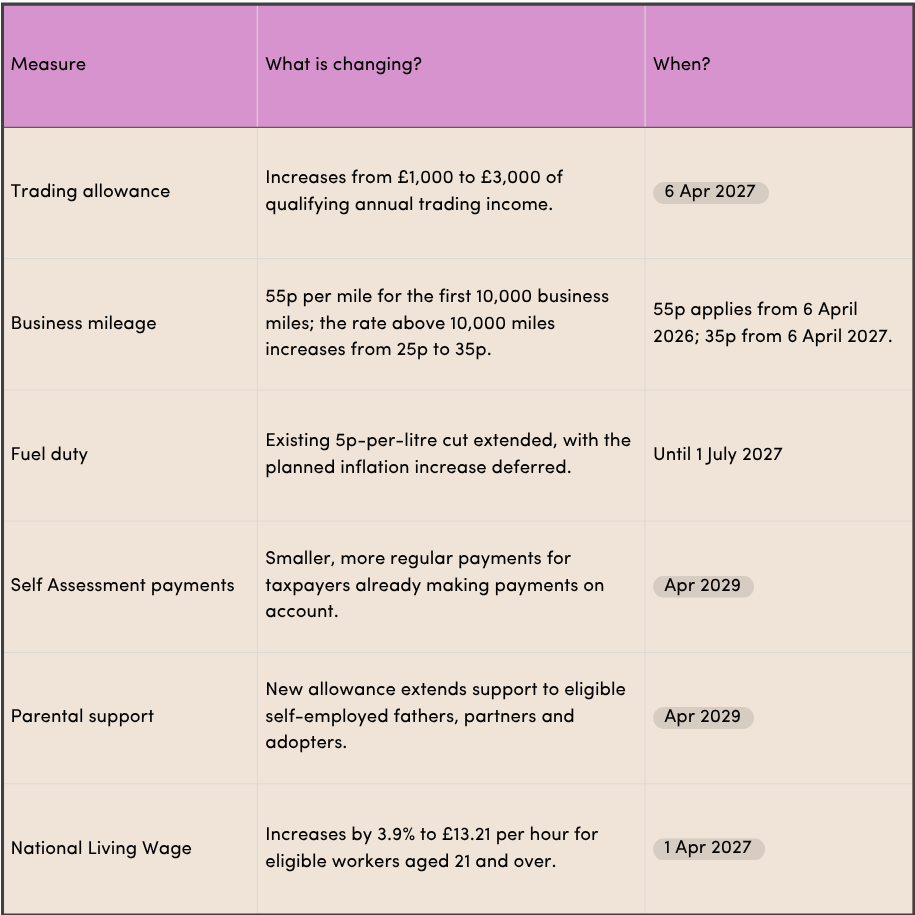
Eligibility and individual circumstances affect entitlement. Mileage deductions reduce taxable profits; they are not a direct payment.
Supporting our high streets and local economies
The Budget also included welcome support for businesses operating from physical premises, particularly in retail, hospitality and leisure.
In England, the increase in the Small Business Rate Relief threshold from £12,000 to £18,000 for qualifying properties will remove approximately 70,000 additional businesses from paying business rates altogether. Others will benefit from reductions or a real-terms freeze.
For independent shops, cafés, hospitality venues and other community businesses operating on narrow margins, business rates can be a substantial cost. Reducing that burden is undoubtedly positive.
The additional support for small brewers and cider makers, alongside measures to address VAT compliance through online marketplaces, also demonstrates a willingness to consider the challenges facing particular sectors.
However, these announcements highlight an important distinction for businesses in Wales.
Business rates are devolved, meaning the measures announced for England will not automatically apply here.
The impact on Welsh high streets will therefore depend on decisions made by the Welsh Government. For businesses in Caerphilly, Newport and communities across Wales, those decisions could be every bit as important as the Chancellor’s announcement itself.
Backing entrepreneurs, investment and growing businesses
There was also additional money for our friends at the British Business Bank.
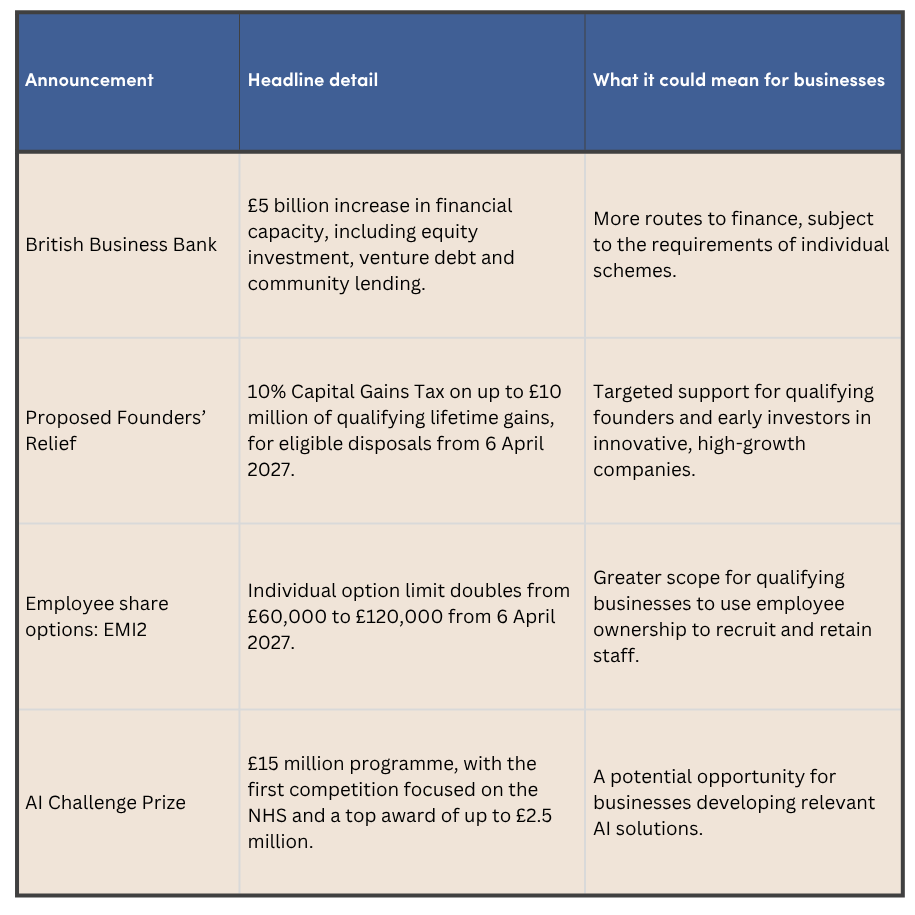
The £5 billion increase in its overall financial capacity, including £1.4 billion for equity investment, £450 million for venture debt and £165 million for community development finance institutions, represents a welcome commitment to helping British businesses access finance.
We particularly welcome the additional commitment to women-led businesses and the development of future investment funds in partnership with devolved governments.
The Budget also included several measures designed to support ambitious businesses as they grow.
The proposed Founders’ Relief will introduce a 10% Capital Gains Tax rate on qualifying gains of up to £10 million over an individual’s lifetime for eligible founders and early investors in innovative, high-growth companies.
Meanwhile, the introduction of EMI2 will double the individual limit for tax-advantaged employee share options from £60,000 to £120,000, helping growing businesses attract and retain talented employees.
Proposed reforms to non-compete clauses could also make it easier for employees to move between businesses, bringing valuable experience and expertise into start-ups and growing companies. Changes to skilled worker visas are similarly intended to improve access to highly skilled international talent.
These are all positive steps towards making the UK a more attractive place to start and grow a business.
However, there is an important distinction between supporting high-growth companies and supporting the wider small business economy.
Not every successful business needs to become a technology unicorn or attract substantial venture capital.
A freelancer earning a sustainable living, a sole trader taking on their first employee or an independent business establishing itself on a local high street can all make valuable contributions to the economy.
While the British Business Bank’s additional investment is welcome, access to finance must be accompanied by investment in the wider business support ecosystem.
For many entrepreneurs, the immediate challenge isn’t necessarily securing investment. It is developing a viable business model, identifying customers, building confidence, managing cashflow or simply understanding the next step.
Through our work at Welsh ICE, we see how much difference the right support at the right time can make. Access to experienced mentors, affordable workspace, supportive business communities and opportunities to develop meaningful relationships can be just as valuable as financial investment.
We have supported hundreds of entrepreneurs at different stages of their business journeys, and their needs vary enormously. Some are developing businesses with significant growth potential, while others are working towards sustainable self-employment or creating opportunities or social enterprises within their local communities.
Additional finance is welcome, but its impact will be significantly greater when combined with locally accessible programmes that help entrepreneurs develop the skills, knowledge and confidence to deploy it effectively.
Skills, apprenticeships and the opportunities presented by AI
Another significant theme was the Government’s ambition to support innovation, develop skills and strengthen the UK’s position in artificial intelligence.
The Budget included additional investment in UK-based AI companies, a new £15 million AI Challenge Prize and further support for domestic data centres and digital infrastructure.
The first AI Challenge Prize will focus on finding solutions to challenges facing the NHS, with a top award of up to £2.5 million. Giving innovative businesses opportunities to solve real problems through public procurement could create valuable opportunities for smaller technology firms.
The Government also announced £100 million over two years to expand local apprenticeship services across English mayoral authorities, helping match businesses with prospective apprentices.
Alongside this, the restoration of the Union Learning Fund in England, with £15 million annually from 2027, aims to support workers in developing new skills, including those needed as AI changes the workplace.
For smaller employers, access to talent and opportunities to develop their workforce remain important challenges. Apprenticeships and more accessible training can play a significant role, provided the systems are straightforward enough for small businesses to navigate.
The emphasis on AI is equally welcome, but it is important that the benefits extend beyond major technology companies and public institutions.
For microbusinesses, AI offers opportunities to reduce administrative burdens, improve productivity and access capabilities that would previously have required substantial investment.
At Welsh ICE, we already work with businesses exploring how emerging technologies can improve their operations and create new opportunities. However, many smaller businesses need practical guidance to understand what these technologies can actually do for them.
This is another area where locally delivered support can be particularly effective. Businesses are more likely to explore unfamiliar technologies when they have access to trusted advice, practical demonstrations and opportunities to learn from other entrepreneurs.
We also welcome the Government’s emphasis on ensuring that data centres contribute positively to the economy without placing additional pressure on energy infrastructure and costs.
The challenge will be ensuring that investment in AI translates into practical benefits for businesses of every size, rather than concentrating those benefits within a relatively small number of large companies.
A different approach to raising revenue
It was also encouraging to see the Chancellor avoid broad increases to the headline rates of Income Tax, National Insurance and VAT.
Instead, the Budget placed greater emphasis on raising revenue through targeted changes, including a temporary increase in the tax surcharge paid by banks and higher rates of taxation on income from property and savings.
From April 2027, savings and property income tax rates will increase by a further two percentage points, while the Government estimates that 88% of people will pay no additional tax on their savings.
There is a reasonable argument for seeking a greater contribution from banks and income generated through assets, rather than placing additional direct pressures on businesses generating revenue through trading activity.
For small businesses already facing higher employment, energy and operating costs, avoiding further broad-based tax increases is welcome.
However, these changes are not without consequences. Some small business owners also rely on income from property or savings, and changes to the taxation of assets may influence investment decisions.
Ultimately, the important question is whether the overall tax environment encourages people to start businesses, employ others and invest in growth.
What does the Budget actually mean for Wales?
As with every UK Budget, there is an additional layer of complexity for businesses operating in Wales.
The Welsh Government will receive approximately £448 million in additional funding over the current Spending Review period through the Barnett formula.
While additional funding is welcome, this does not necessarily mean equivalent programmes will be introduced in Wales.
The Welsh Government has its own priorities and spending pressures, meaning funding associated with announcements in England may be allocated differently here.
We have already seen confirmation that Wales will introduce the £100 cost-of-living payment for households in council tax bands A to D, mirroring support announced in England.
However, considerable uncertainty remains around business rates, entrepreneurship programmes and other targeted business support measures.
With the Welsh Budget scheduled for 17 November, the coming weeks will be important in understanding what these announcements mean in practice for Welsh businesses.
There were also welcome direct investments, including £30 million towards Cardiff Parkway station and support for infrastructure and innovation projects elsewhere in Wales.
Nevertheless, the wider question remains: how much of the additional funding will translate into direct support for entrepreneurship, small businesses and local economic growth?
Local people know their economies best
One of the more interesting developments in the Budget was the commitment to give English mayors greater control over economic development.
The proposed expansion of financial powers, including greater retention of business rates and access to additional investment mechanisms, could provide local leaders with more flexibility to respond to the needs of their economies.
This is an approach we strongly support.
At Welsh ICE, our experience of delivering business support across different communities has demonstrated just how varied local economies can be.
The challenges facing an entrepreneur in a former industrial community in the Valleys may be very different from those facing a technology start-up in Cardiff or a rural business in Mid Wales.
Local authorities, community organisations and regional partnerships understand the businesses, industries and opportunities within their areas. They are well placed to identify gaps in provision, respond to emerging challenges and develop support that reflects local circumstances.
Giving these organisations greater control over economic development funding could help create more responsive and effective support.
It is therefore disappointing that the expansion of local economic powers announced in the Budget appears to be focused on England, with no equivalent commitment for Welsh local authorities.
Wales already has a different economic development landscape, involving the Welsh Government, local authorities, regional bodies such as Cardiff Capital Region, Business Wales and the Development Bank of Wales.
Added to this is the Welsh Government’s commitment to establish a new Welsh Development Agency, with an expert advisory panel currently considering its future structure and responsibilities.
We welcome the ambition to strengthen Wales’s economic development capabilities, attract investment and improve productivity.
However, its success will depend on how effectively it works with the organisations already supporting businesses throughout Wales.
What will the new agency be responsible for, and how will that complement the existing work of Business Wales, the Development Bank of Wales and regional economic partnerships?
How will Cardiff Capital Region and individual local authorities contribute to shaping investment priorities and deciding where resources are allocated?
And, as English mayors gain greater financial autonomy, will Welsh councils and regional bodies receive similar powers to support their local economies?
Our view is that decisions about local economic development should be made as close as possible to the communities and businesses they affect.
National organisations have an important role in attracting investment, developing economic strategy and providing specialist resources. However, local and regional partners should have meaningful control over how economic development programmes are designed and delivered within their areas.
For a sole trader or start-up founder, navigating the existing business support landscape can already be challenging. Between UK Government programmes, Welsh Government initiatives, regional investment funds and local authority services, understanding what support is available and who is responsible for delivering it can be difficult.
The introduction of another national organisation must not make that landscape more complicated.
The proposed Welsh Development Agency should strengthen the ability of local and regional partners to deliver effective support, ensuring that investment and resources reach businesses through organisations that understand their communities.
We have seen first-hand the value of locally commissioned programmes that respond to the needs of a particular area. Working with local authorities across South Wales, Welsh ICE has delivered business support, entrepreneurship training and mentoring that reflects the challenges and opportunities within each community.
These programmes benefit from local knowledge, established relationships and the flexibility to adapt delivery around the people and businesses they support.
The expansion of regional economic powers in England should prompt a wider conversation about whether Wales’s existing arrangements give local areas sufficient influence over their economic futures.
For us, the priority is clear: stronger regional powers, greater local flexibility and sustained investment in the organisations already working directly with entrepreneurs.
Will these measures actually improve conditions for small businesses?
Taken individually, the majority of the Budget’s announcements are difficult to argue against.
Lower business costs, improved access to finance, targeted tax reliefs, support for entrepreneurs and investment in infrastructure are all positive developments.
But the more difficult question is whether these measures will make a material difference to the experience of running a small business.
For many microbusinesses, the immediate challenges remain unchanged. Energy prices are high, customers are cautious with spending, borrowing remains expensive and the cost of employing people continues to increase.
The Budget offers some relief from these pressures, but it is less clear whether it fundamentally improves the environment in which small businesses operate.
There is an important difference between policies that help businesses grow and policies that simply reduce the extent to which their circumstances become more difficult.
Both are valuable, particularly during challenging economic conditions. However, we should be realistic about the distinction.
For a business struggling with reduced consumer spending, a modest saving on fuel or tax may be welcome without necessarily being enough to justify recruiting another employee, investing in equipment or expanding into new premises.
We also shouldn’t overlook some of the everyday challenges that remain unresolved, particularly late payments and access to affordable finance.
For many small businesses, getting an invoice paid on time can have a more immediate impact than an additional tax incentive or investment scheme.
The success of this Budget should ultimately be judged by whether it creates the confidence and conditions for businesses to invest, employ and grow.
Uncertainty remains the biggest challenge
Perhaps the most important caveat comes from the Office for Budget Responsibility’s economic forecasts.
The OBR expects economic growth of just 1.2% in 2026, falling to 1% in 2027, while inflation is forecast to peak at 3.8% early next year.
Crucially, the OBR highlights the substantial uncertainty surrounding these projections, with significantly better or worse outcomes both plausible.
The continuing conflict in the Middle East, volatility in global energy markets and the resulting pressures on inflation and interest rates make economic forecasting particularly difficult.
Much of this uncertainty is beyond the direct control of the Chancellor, and it would be unreasonable to expect any single Budget to eliminate it.
Nevertheless, uncertainty is particularly challenging for small businesses.
Large organisations may have the financial reserves, resources and flexibility to absorb unexpected changes. For sole traders and microbusinesses, even relatively small increases in costs or reductions in income can significantly affect their ability to operate.
Confidence is essential to investment, recruitment and entrepreneurship. When businesses cannot reliably anticipate their costs or future demand, making long-term commitments becomes considerably more difficult.
Our verdict
Overall, this was a Budget containing a significant number of welcome announcements for small businesses, sole traders and freelancers.
It was encouraging to hear the Chancellor explicitly recognise their contribution to the economy and the particular challenges they face.
The measures announced offer some much-needed relief, while commitments to entrepreneurship, investment and business finance provide reasons for cautious optimism.
However, the true impact will depend on implementation, the decisions taken by devolved governments and, ultimately, the wider economic conditions in which businesses operate.
For Welsh businesses, there are still important questions about which measures will be replicated, how additional funding will be prioritised and whether local authorities and regional partnerships will have the powers and resources needed to support economic growth.
We welcome the proposed investment in the British Business Bank and the ambition behind the new Welsh Development Agency, but both must recognise the importance of the existing business support ecosystem.
At Welsh ICE, we believe sustainable economic growth starts with giving entrepreneurs the confidence, connections and practical support to succeed. We also believe that local people and organisations are best placed to understand what their communities need.
The Budget contains plenty of positive announcements. What matters now is whether they make a meaningful difference to businesses, and whether Wales gives its regions and communities the resources and freedom to build on those opportunities.